

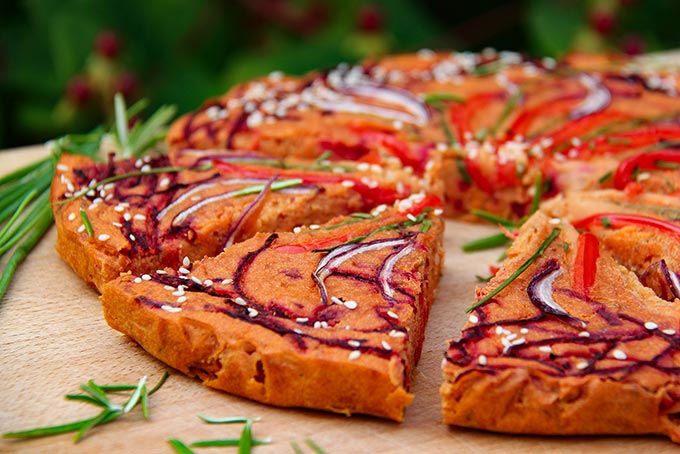
This vegan baked farinata slice recipe is one of my favourite simple chickpea flour creations. It’s vegan, oil-free, gluten-free, incredibly versatile, and can be made with just a handful of ingredients.
I’ve been teaching this baked farinata slice on plant-based retreats for years – it’s one of the most requested recipes because even first-time bakers nail it. Guests often make their own versions with colourful toppings arranged in beautiful patterns.
Over the years I’ve tested different ratios of chickpea flour, vegetables, and liquids to get the texture just right for a slice that sets well but stays tender inside. It began when I bought a bag of chickpea flour and started experimenting with simple savoury bakes. I wanted to make a wholesome, nourishing vegan slice.
After experimenting with the simplest ingredients – chickpea flour, water and salt – I discovered that I could bake it into a nourishing slice that could be cut into wedges and eaten as a snack.
I wanted something that was quick, easy, fool-proof, that I could add other plant-based ingredients to. That’s the great thing about this farinata slice. It’s super versatile. You can add any vegetables to it.
This farinata slice can be served hot straight out of the oven to go with salad. It works nicely cold too as a lunchbox snack. Excellent hiking food. It keeps for several days afterwards in the fridge. It features in my extensive healthy dinners recipe collection too.
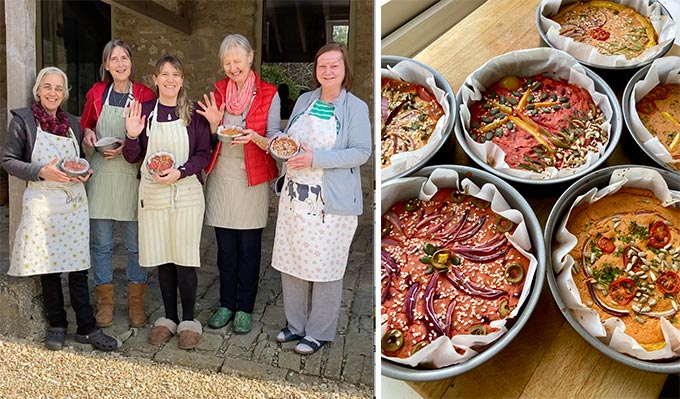
Guests on Anastasia Eden’s plant-based retreat making baked farinata slices
Why you’ll love this baked farinata slice
- Naturally vegan and gluten-free
- Oil-free (no oils needed)
- Very simple ingredients
- A great way to use chickpea flour
- Versatile toppings – vegetables, herbs, seeds
- Delicious hot or cold
- Keeps for several days in the fridge
What is farinata?
Farinata is a traditional Italian dish made from chickpea flour, water, olive oil, and salt, baked in a hot oven until golden. It originates from the Liguria region of Italy, where it has been a beloved street food for centuries.
Its origins are thought to date back to the 13th century, during a famous naval battle between Genoa and Pisa. Legend has it that chickpea flour and olive oil were soaked with seawater during a storm, then dried in the sun – and the first farinata was born by accident. Others say the Romans had been roasting chickpea batter on their metal shields long before that. Whatever the true story, farinata has travelled far beyond its origins, appearing as socca in the south of France, and fainá in Argentina.
My baked farinata slice is a slightly thicker, more generous version – and unlike traditional recipes, it’s completely oil-free. One you can cut into wedges, load with toppings, and take on a hike or serve at a retreat table.
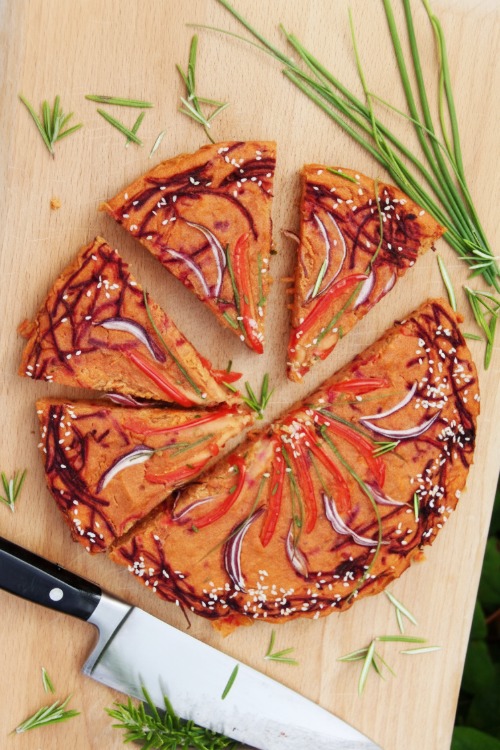
Tips for the best baked farinata slice
1. Mix the batter well
Chickpea flour can form lumps easily, so whisk slowly as you add the liquid.
2. Let the batter rest (optional but helpful)
If you have time, letting the batter sit for 20–30 minutes improves texture.
3. Don’t overload the toppings
A thin layer of toppings works best so the slice cooks evenly.
4. Use parchment paper
This prevents sticking and makes it easy to remove the slice.
Farinata variations
You can adapt this basic farinata slice (recipe below) in many ways. One of the most popular ways I’ve found is to add roast vegetables is in these roast parsnip & potato farinata slices. My baked leek & mushroom farinata version is also an excellent option.
Other variations could include…
Mediterranean
- olives
- rosemary
- tomato
Garden vegetable
- courgette
- red pepper
- spring onion
Spiced version
- turmeric
- coriander seed
- chilli flakes
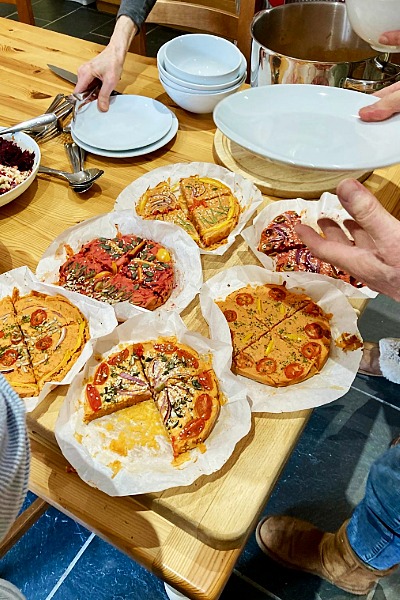
How to store farinata
- Store leftovers in an airtight container in the fridge.
- Keeps well for 3–4 days.
- Can be eaten cold or reheated in the oven (cover it if it risks drying out).
What to serve with baked farinata?
If you are creating your baked farinata as part of a hot lunch or brunch, then it works wonderfully with homemade smoky black beans, avocado and turmeric potato patties, or even a hearty side salad.
For dinner it serves a treat with quinoa, potato wedges, and salads. A sauce dollop on top, or on the side always works a treat. I am thinking about my posh homemade ketchup or my tahini sauce.
It works whole and complete within itself if you want it for hiking food.
Here is the simple baked farinata slice recipe I make regularly at home and on retreat…
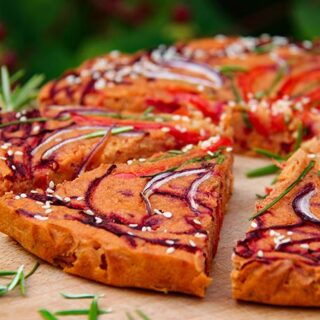
Baked Farinata Slices - vegan, gluten-free
A healthy vegan baked farinata slice made with chickpea flour, water, sea salt. Oil-free, gluten-free and very pretty version.
Ingredients
- 225g chickpea flour (also called besan/gram/garbanzo bean flour)
- 1 heaped teaspoon sea salt (or to taste)
- 1 heaped tablespoon onion powder (or granules)
- 1 to 2 teaspoons cumin seed
- ½ to 1 teaspoon lazy chilli from a jar (or fresh chilli/dried chilli)
- 150g grated carrot (or beet, sweet potato or parsnip)
- 225ml water
- 225ml passata
Instructions
- Grate your carrot or other root veg.
- Slowly add the liquid to the chickpea flour. Mix thoroughly as you add the liquid to make sure there are no lumps and the flour is evenly mixed. It helps to add liquid slowly for even mixing. Alternative you can blend it with a hand blender for a rapid lump free batter.
- Mix all of the remaining ingredients in.
- Pour the batter into a small, parchment-lined baking tin or oven proof dish. Use a 9 – 10″ round tin or flan dish (you can vary this depending on what you have available).
- Prepare and arrange any toppings (see notes below for ideas). Placing a thin layer of toppings is best.
Please avoid more chunky toppings as they add to overall cooking time. - Bake in a pre-heated oven at around 190C for about 25 minutes.
Notes
Farinata Topping Ideas
- Sweet pepper (different colours)
- Tomato
- Broccoli sprinkle
- Sesame seeds
- Rosemary
- Spring onion
- Chives
- Olives
- pumpkin seeds
Equipment
- A 9 – 10″ round tin or flan dish (you can vary this depending on what you have available).
- Parchment paper
- A hand blender (optional)
Frequently Asked Questions About Baked Farinata
What does farinata taste like?
Farinata has a mild, slightly nutty flavour from the chickpea flour. When baked, the outside becomes lightly golden while the inside stays soft and tender.
It pairs beautifully with herbs, vegetables, spices, and savoury toppings, which makes it a very versatile base for different flavour combinations.
Is farinata gluten-free?
Yes. Traditional farinata is naturally gluten-free because it is made with chickpea flour rather than wheat flour.
This recipe is also completely gluten-free as long as all additional ingredients and toppings are gluten-free.
Is farinata vegan?
Yes. Classic farinata recipes are naturally vegan, as they are made with chickpea flour, water, olive oil, and salt.
This baked farinata slice is also fully plant-based and works beautifully as a vegan lunch, snack, or light meal.
What is chickpea flour?
Chickpea flour is a flour made from finely ground dried chickpeas. It has a slightly nutty flavour and is widely used in many cuisines around the world.
It is also known as:
- Besan or gram flour (commonly used in Indian cooking)
- Garbanzo bean flour (often used in the USA)
Chickpea flour is naturally gluten-free and high in plant protein.
Do you need to let farinata batter rest?
Traditional farinata recipes often recommend letting the batter rest for a few hours before baking. This allows the flour to fully hydrate and can improve the texture slightly.
For this baked farinata slice, resting the batter is optional. If you have time, letting it sit for 20–30 minutes can help create a smoother batter, but it will still work well without resting.
Why is my farinata batter lumpy?
Chickpea flour can sometimes form lumps when liquid is added too quickly.
To avoid this, slowly add the liquid while whisking the batter. You can also use a hand blender to quickly create a smooth, lump-free mixture.
Can I add vegetables to farinata?
Yes. One of the best things about this baked farinata slice is how adaptable it is.
You can add grated vegetables directly into the batter or arrange sliced vegetables and herbs on top before baking.
Some good options include:
- sweet pepper
- tomato
- courgette
- broccoli
- spring onion
- olives
- herbs such as rosemary or thyme
How do you store baked farinata?
Once cooled, store farinata in an airtight container in the refrigerator.
It will keep well for 3–4 days and can be eaten cold or reheated in the oven until warmed through.
Can you freeze farinata?
Yes. Farinata freezes well.
Allow it to cool completely, then slice it into wedges and store in an airtight container or freezer bag. If you have pepper on it, then that’s the only part that doesn’t freeze so well as it is watery. So leave out any pepper if you are going to freeze your farinata.
To reheat, bake in the oven until warmed through and lightly crisp again.
Can farinata be eaten cold?
Yes. Farinata is delicious both hot and cold.
Fresh from the oven it is soft and warm, while chilled slices make a convenient snack, lunchbox option, or portable food for picnics and hiking.
Is farinata healthy?
Farinata can be a very nourishing food because it is made primarily from chickpea flour. Chickpeas are naturally rich in plant protein, fibre, and important minerals such as iron and magnesium.
Because this baked farinata is made with simple whole-food ingredients and vegetables, it can be a satisfying and balanced option for a light meal or snack.
Is chickpea flour high in protein?
Yes. Chickpea flour contains significantly more protein than many common flours.
It typically provides around 20–22 grams of protein per 100 grams, which makes it a popular ingredient in plant-based and gluten-free cooking.
This is one reason farinata can feel very satisfying despite being made from just a few simple ingredients.
Why is my farinata soft in the middle?
A soft centre is normal, especially with thicker baked farinata slices like this one.
However, if it seems undercooked, it may need a little more time in the oven. This can happen if:
- the baking dish is deeper
- many toppings are added
- the oven runs slightly cool
Simply bake for an additional 5–10 minutes until the top feels set and lightly golden.
Can you make farinata without olive oil?
Yes – and in fact this recipe is completely oil-free.
Traditional Italian farinata usually contains olive oil, but I’ve found that with good parchment paper and the right batter consistency, you get a beautiful result without any added oil. The texture is tender inside with a lightly set surface, and nothing sticks.
If you do want to add a little olive oil for a more traditional flavour, a tablespoon stirred into the batter works well.
What pan is best for baking farinata?
Traditional farinata is often baked in large shallow metal pans at very high temperatures.
For home cooking, a 9 to 10 inch round baking tin, flan dish, or shallow ovenproof dish works very well. A shallow pan helps the batter cook evenly and develop a lightly golden surface.
Why does farinata sometimes stick to the pan?
Farinata can stick if the pan isn’t well prepared.
To prevent sticking:
- line the pan with parchment paper (I highly recommend this), or
- lightly oil the pan before pouring in the batter (less reliable, but can work if it’s extremely hot on baking)
Allowing the farinata to cool slightly before removing it from the dish can also make it easier to lift out.
Is farinata the same as socca?
Farinata and socca are very closely related dishes made from chickpea flour batter baked in a hot oven.
Farinata comes from Italy, particularly the Liguria region, while socca is a traditional street food from the south of France, especially around Nice.
The ingredients are very similar, although seasoning and thickness can vary slightly depending on the region.
Can you make farinata thicker like a slice?
Yes. While traditional farinata is often quite thin, the batter can also be baked slightly thicker to create a slice that can be cut into wedges.
This is the style used in this recipe, which makes it ideal for toppings, packed lunches, picnics, or serving alongside a salad.
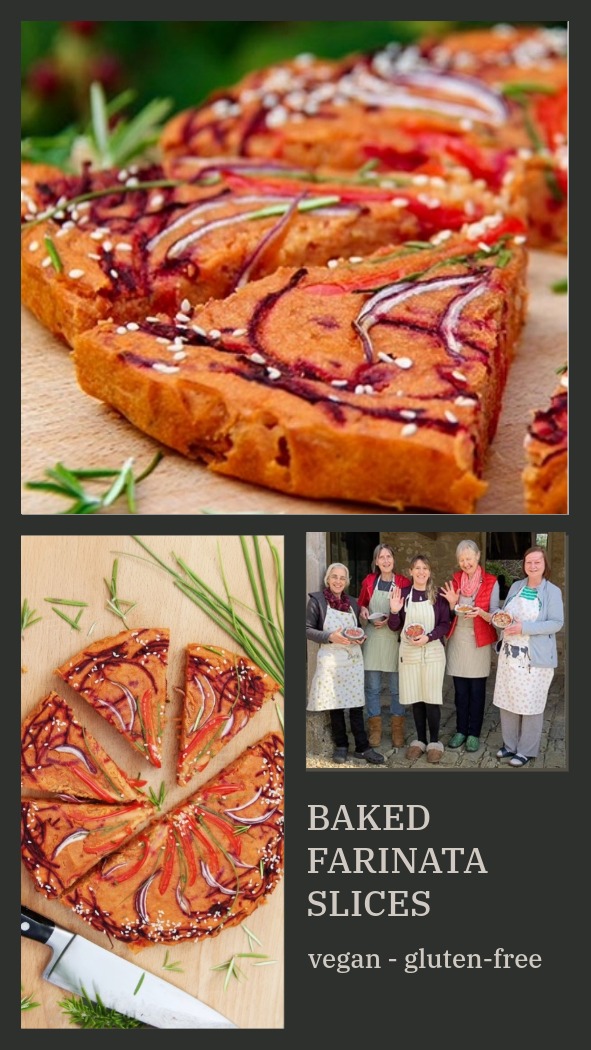
Pin oil-free vegan baked farinata slices for later…

Leave A Comment